Monday, October 5, 2009

Interbike wrap-up

The last week of September I had the pleasure to attend the yearly industry show for bike people. It's held, in all places, in Las Vegas, Nevada. I'm not sure why an industry that sells products that can be used for sustainable living has its trade show in the most unsustainable city in the US. But then again, a lot of the bike industry is not actually about sustainability. Las Vegas is one of those cities that exemplifies America's extremes in so many ways. Founded at the site of a spring, on the dry dusty road from all parts East to California, it became a true Oasis in the desert and outpost for weary travelers looking for liquor, women, and an overall good time. It grew from there into a sprawling city, dependent on ever diminishing water supplies from the Colorado river and the underground water stores of the southern half of Nevada, in a location with so little rainfall that cactus hardly grow there. Of course, tourists can spend a pleasant vacation on the lavish Strip, enjoying shows, nightlife, shopping, etc., all without hardly even leaving the overly air conditioned confines of the massive and convoluted casinos and hotels. It is actually difficult to find your way outside at times (and for me it was refreshing to finally break out into the heat and light of the street). They never have any idea of how precarious the city is, perched on the edge of the environment like that.

The first couple days of the show are the "outdoor demo". They bus you out to Bootleg Canyon, which is a mountain biking destination, where the bike vendors bring bikes for you to try out. I tried some mountain bikes from one of our suppliers, Marin Bikes. We carry primarily their city line, but they're well known for mountain bikes.
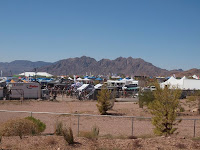
I checked out a bike and rode it around the trail with about a hundred other bikers. The trail had some challenging whoop-de-whoops that I've gotten too wimpy to ride. (I find that as I get older and have more responsibilities, my level of comfort with physical risk has gone down somewhat. ) But the ride was fun and it was good to try out a few different bikes that I probably would never own (full carbon mountain bike anyone?), and try samples of energy bites, bars, and drinks. The energy bites are good, but I wonder about classifying them as food? One particular free drink sample was neon orange colored and had a list of ingredients about 40 long, including amino acids, vitamins, various protein supplements, energy boosters, and not sure what else. Talk about highly engineered! It tasted ok, but I couldn't bring myself to drink too much of it - call me old fashioned, but I like to be able to identify what I put in my body.


In addition to the mountain bikes, I also rode some new Xtracycle Radishes (completely loaded down with watermelons for the true cargo biking experience), a smattering of electric-assist bikes from iZip and some newer companies, touring bikes by Masi (one of our new lines), some commuting bikes by Civia, an electric-assisted Day 6 bicycle, and (my favorite) a prototype Auto-shift from Nuvinci. Nuvinci makes an internal rear shifting hub that uses roller balls and spline plates instead of gears, giving you a continuous range of shifting. This is the hub Morgan used on the Firefly big dummy. Their new auto-shift prototype uses a pedal sensor that detects how much torque you are applying and changes the "gears" for you (using an electronic interface) to try to keep your pedal cadence the same - just like automatic transmission in a car! It worked better than I expected and you never had to think about shifting, which was great. I'm not an early adopter of new things, tending to be somewhat skeptical, but I was pleasantly surprised by this bike and liked it much more than I thought I would. Currently, the product is available on a limited basis, as it's still a beta product, but I think there is some potential there for the future.

I also was quite impressed with the Civia Hyland commuter bike. This bike is designed with commuters in mind, with full coverage fenders, comfortable riding, internal gearing, hidden cable routing, rack, etc. The bike rode really well and I was quite impressed with it's nimbleness and how easy it was to climb up the hills. It's price tag is quite high, but for serious commuters, I think worth it. The line is also coming out with some scaled back versions this spring, which we may decide to pick up.

After the dusty outdoor demo, the show moves inside to the conference center. My hotel was about a mile from the conference center, but I brought a Downtube folding bike to get around. Most of the streets in Las Vegas are wide boulevards and many of them have a reasonably wide outside lane and even a bike lane, which makes getting around by bike quite reasonable if you are comfortable with traffic. The first day of the outdoor demo, the show-related bike lock up was not open, so I wandered around the outside of the building until I found employee entrance, with about 15 bike racks set up to the side of the parking garage. The racks were jam packed with assorted bikes, but mostly BMX bikes and Huffys. Apparently, biking is quite a popular mode of transportation among the working class of Las Vegas. I saw a number of people riding around wearing the white and black uniforms of food service workers.

The indoor show is just aisles and aisles of vendor booths, large and small, some fancy and some simple. There are a lot of booths that I could bypass, catering to high end road and mountain bikes, components, etc - recreation and racing oriented bikes. But there is a growing number of vendors looking for the commuter, utilitarian, electric, and city bikes. All of the major bike vendors have their city bike lines, and this year we are seeing a lot more classic and european styling in these designs.


Our own Marin bikes have introduced a very nicely styled and inexpensive city bike in their Bridgeway line. Starting at under $500, these bikes are your basic commuters, now with good looks!

There is also growing interest in actual European designed bikes, and I saw some interesting offerings in that area. We are considering picking up some dutch bikes by Batavus. This is one of the oldest bike companies in the world and has been offering solid, low maintenance, stylish bikes that c
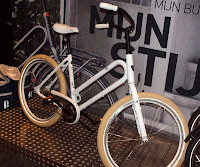
an be ridden in dresses and suits or jeans and t-shirts all without worry. No fancy biking clothes or equipment needed. Just get on and ride, and do it in style. They are introducing some very inexpensive BUB bikes that can be stylized to your own taste, but still have the solid and stylish design of a dutch made bike. These looked pretty interesting, with 2 frame types.


I also saw some very classic bikes offered by Pashley of England. The Sonnet Bliss was on display at the booth and simply looked fabulous with clean lines, white with red accents. These bikes are still hand made in England and sell for just over $1,000 - hard to believe.


Outside of the european world, the fixed gear bikes continue to gain ground. Our new line of bikes by Masi, has a number of fixed gear options and styling from low key to flashy. Look for these in the store soon.

One of the fun things I did while at the show was attend the Urban Bike Fashion Show, sponsored by Momentum Magazine and Giant bikes. Momentum Magazine is a pretty cool new publication out of Vancouver, BC, that is dedicated to people who use their bikes - definately worth checking out. The fashion show had a circular runway laid out, and the riders would ride around, stopping the bikes 3 times to get off and showcase their outfits and the bikes. I wasn't sure what to expect, but it was pretty fun and there were lots of interesting bikes (and they served free beer, so how can you go wrong!). I'm sure there were interesting clothes as well, but I didn't look at those as closely! The Nutcase helmets we carry were prominently showcased in the show, given their unique and interesting designs. The bikes ranged from classic to modern and even included a Madsen bike and an electric-assist bike. It was nice to see biking at a level beyond just the performance/recreation market and also beyond just the utilitarian market. Biking as a real lifestyle choice.


The fashion show was about the last thing I did before heading back to North Carolina. It was a fun time and I saw some interesting bikes and things. Look for some of these things to be showing up in the shop soon.
-Elise

Wednesday, September 9, 2009

Helmet laws are not the answer

It is campaign season again, and there are a number of candidates running for the Board of Aldermen in our sleepy little town of Carrboro, NC (right next to Chapel Hill, NC).

Just a few days ago, Sierra Club held a candidates forum. One question they asked the candidates was how they might improve safety for cyclists and pedestrians. While we found all of the responses to be lacking (perhaps in part due to the reporting in the newspaper), one particularly stood out. Randee Haven-O'Donnel is claimed to have said we should pass an adult helmet law, mandating that we all wear helmets.

NO WE SHOULD NOT PASS A MANDATORY HELMET LAW! I rarely if ever yell in this blog, but this one warrants a big yell.

Many places have tried mandatory helmet laws, and it has been a miserable failure wherever and whenever tried. Australia is the biggest case in point. Seven years after the mandatory helmet law was passed, the cycling population dropped by 22%. At the same time, the total number of bicycle injuries increased.

Some may be scratching their heads. How could that be? Why didn't this law instantly make people safer?

Because one-size-fits all laws like this usually have unintended consequences. One consequence is discouraging people from riding at all. And study after study has shown that cyclists have safety in numbers. The numbers go down because of helmet laws, and safety goes down. There may also be a factor of risk compensation - people riding faster and more aggressively when wearing a helmet. But the reasons really do not matter. Because the facts are the facts - and those facts aren't unique to Australia.

The same experiment was born out in New Zealand, which also passed a mandatory helmet law, and also saw a reduction in cycling by 51%, and saw only a 51% drop in fatal accidents. In other words, less people are biking, and less accidents are occurring, by the same amount. The helmet law is making people no safer, while it is preventing many people from biking.

We're not anti-helmet, we're anti-helmet law. In fact, all the owners and employees of Cycle 9 regularly wear their helmets. We help many of our customers get fitted out with a helmet.

But helmet laws just don't work. And worse, they promote a nanny-state mentality that every risk we might take must be proscribed by legal decree. We believe bikes are about freedom, not laws. Maybe that's why less people cycle when helmet laws are passed - the association of riding a bike with a sense of freedom becomes diminished.

Biking should be a free activity. An adult should be able to choose how she regards his or her own risks and rewards from either wearing or not wearing a helmet. This would be true even if helmet laws did work. But it is especially true since mandatory helmet laws don't work.

I hope that Ms Haven-O'Donnel and the other Aldermen/women don't go down that route. It may benefit certain helmet manufacturers, but it won't benefit anyone else.


Sunday, August 23, 2009

Cory and his Surly 1X1

Here is a brief profile of a recent, happy customer who took delivery of a custom-assembled bike by Cycle 9. One reason for profiling Cory is to get the word out that Cycle 9 is not just an "electric bike" store. Some people have come to see us that way. It really hit home recently, when one of our friends went out and purchased a new commuting bike, without even having a look at what we had to offer in our store. Seeing that we have a full inventory of non-electric commuting bikes by Marin, Breezer, Surly, and Downtube, I was a bit offended. But since I talk about electric bikes and electric conversion kits so often, it is understandable that some people think Cycle 9 = electric. We are actually about getting people to ride their bikes more, whether electrified or not. Bikes are the ultimate local transportation solution, and we're here to help people realize that.

Cory and his Surly 1x1 with Nuvinci Hub
Cory with his brand new Surly 1X1, with Nuvinci continuous variable hub (not an electric bike).

Cory wanted a better way to commute that was virtually maintenance-free, like a singlespeed would be. However, his commute involves traversing hills with over 20% grades, often carrying a loaded backpack. He didn't feel that this would be practical on an every day basis with a singlespeed bike. With Cory's input, we came up with a great solution for him. We started with Surly's great singlespeed platform, the 1x1. We added to it an internally geared, continuously variable hub by Nuvinci, with a custom wheel built by Cycle 9. On top of that there are nice touches like the Surly Mr Whirly crankset and Soma Noah's arc handlebars, and Cory has a bike that is rock solid, will require very minimal maintenance, and gives him an extensive gear range for hill climbing. This is a bike that will still be running in 20 years. It was not inexpensive, but it will far outlast many of the less expensive bikes, being a much better bargain in the long run.

This is the kind of solution we're here to help people with.

To Maine on the train

Jim Kunstler is famous, or perhaps infamous is a better word, in the "peak oil" community for his prophecies of gloom and doom to be set upon the USA due to our profligacy and oil dependency.

Kuntstler is a controversial figure, in part because he constantly predicts doom to beset us, and in part because of his rather loudmouth style that includes lots of swear words to make his point. While some of what Kunstler says may hit some underlying truths about whether our lifestyles are sustainable (or not), his message is weakened by a few problems. First, the constant prophecies of doom don't come true. And second, he is a hypocrite.


In his most recent blog post, titled "The First Die-Off" he talks about driving his car back from a vacation on Cape Cod, and being stuck in traffic. He claims there is "no train service" and uses that as his excuse for having driven the car.

Please.

I just came back from a trip to Maine on the train, with 3 small kids in tow. We stayed on the beach in a town not all that far north of Cape Cod (south of Portland, Maine). The train was comfortable, relatively convenient, and relatively cost effective. We rented a bike once we were there, and used it for most of our errands.

Kid walking on beach of Biddeford Pool
Kid on the beach in Maine


It annoys me to no end to have someone like Kunstler constantly harping on "the end of the world as we know it," and then in the very same essay, to be so blatantly participating in the very activities he laments as leading us to The End.

In fact, from the comments section by user "signalfire" after his blog post:

Isn't the problem that EVERYone thinks THEY are the ones who are 'special'?? THEY deserve a holiday at the beach. THEY deserve cheap energy. THEY deserve big houses. THEY deserve their Escalades, Hummers and Jet Skiis..


This hits the nail on the head. Why does Kunstler preach that we're going to have a massive die-off on the one hand, and yet so blithely participate in the very same activities, such as driving to and from the beach? People pay attention to him. If he had taken the bus, or ridden his bike, or taken the train, then his diatribes might not have seemed quite so silly.

I noticed something in the small town of Biddeford Pool that we stayed in. It was an excellent place for getting around by bike or foot - except that there was so much tourist-related automobile traffic, that it wasn't that great. One of my friends there, who likes to bike, remarked that it would be great if there were less traffic. The very same person was the one out driving the car nearly every day to run this errand or that, such as to pick up morning newspapers.

Sunset view from Maine Cottage
Biddeford Pool, ME

The main difference between my friend and Kunstler is that one might expect Kunstler to know better, given that talking about Peak Oil is the main focus of his life. His efforts to educate people on the topic are greatly diluted by such obvious hypocrisy.

I don't claim to be perfect - I consume some oil, too. But I make efforts to minimize it, and set an example as to how life can be enjoyed with a minimum of oil. Aside from taking the train as frequently as possible for trips - which I've come to really enjoy - I like to show that bikes can be used for tasks that people often think of as requiring a car. The most recent example is the move of several heavy server systems from my Lab from an old location in an out of date server room to a much more modern facility. The computers are 8-core Apple Xserves, each weighing about 40 lbs. I readily carried two of them together, totaling about 80 lbs, on my bike, and the errand was far quicker than it would have been by car, because parking on campus is a nightmare. With the bike, I rode right up to the door at both the starting point and the destination. Later, when we have to move 40 of them, I'll enlist the Yuba Mundo, a bike that can carry up to 400lbs or so of cargo. By moving 8 of them at a time, with each trip taking only 5 minutes, we can have the moving part done in under an hour.

Moving an Xserve by bicycle
Moving 2 Apple Xserve servers on the electrified Surly Big Dummy bicycle


So I challenge James Kunstler: if you're serious about all this gloom and doom, then go out and set an example of how to avoid it. Show us the alternative. Don't just whine about how bad it is going to get. Help provide an alternative.

That's what I'm doing in my "spare time" - helping customers of Cycle 9 find oil-free alternatives for every day errands and tasks. Really, I don't have any spare time - with small kids at home and a more than full time faculty job, my life is often seen by others as "insane". People ask me how I do it. How I do it is by being inspired to help people. The thing that keeps me going is seeing the joy of people whom we help discover there is a better way than dependency on the oil companies. A way that is healthy and brings regular joy in the way that being stuck in a car in traffic does not. The latest example is Cory, who is profiled in the next blog post.

Kunstler, it is your turn to help people find a better way, rather than just being seen as a whiner.

Friday, August 21, 2009

electric bikes don't give no exercise!

On Wednesday evening I dusted off my poor road bike, a Lemond Buenos Aires, to take her out for a ride. I hadn't been on her for 6 months or so. The tires were flat, and the chain needed a serious lube. I got her going, and went out in the popular Dairyland area North of Chapel Hill and Carrboro, NC, for a pleasant ride in the rolling hills (some would say these hills are more than rolling).

Starting out, I thought that I was going to suck wind on this ride, since it was my first ride in so many months on the road bike (which does not have electric assist!). In fact, aside from my electric assist Big Dummy, the only other bike I've been on in the past six months is my 29er mountain bike - exactly 3 times. My life is way too busy right now for regular recreational rides on the road bike or the mountain bike. The only bike I have time to ride is the one I get to and from work on and do errands on - which has an electric motor that some folks tell me they consider "cheating".

I have a cycle computer, and being somewhat of a geek, I like to keep track of my stats when I'm on my bikes. But, for my road bike ride, I didn't want to look at my average speed during the ride, because I figured it would be so slow. Instead I just kept the distance displayed. I noticed many times that my instantaneous speed was hovering around 20 mph, and a few times that it dropped down to 14-15 mph on a big hill, but I thought I was doing ok. Well, except for the time that a pack of hard-core racer types - all guys - whizzed past me going 23-25 mph. I held them off on a hill, but once we got to the flat stretch, they were gone.

Anyway, after my 21.4 mile loop with 1,043 ft of climbing (plus 7 miles to/from home), I stopped and checked the average speed: 18.91 mph - very close to 19 mph. This is not Olympic level riding - but neither is it slouch riding. Even back when I was training on the road bike regularly, I rarely would average much over 19 mph when riding by myself (and often 22-23 mph or so in a group for this hilly area).

There goes another nail in the coffin of the myth that "electric bikes don't give you exercise" or "electric bikes are cheating". I couldn't have pulled off that kind of speed if I hadn't been riding almost every single day on my electric cargo bike. Some days on my electric bike I don't pedal very hard, if I'm feeling tired. Other days I pedal a lot to get the exercise. But I do pedal, every day - because I feel goofy riding the bike without pedaling.

It reminds me of a customer whom we're going to profile soon on video. She bought an electric eZee hub motor kit from us last year. She put it on her commuting bike, and logged over 2,000 miles on it in the past year. In the process, she lost 90 pounds! She recently brought her bike in to have us take the motor off, and to put that on a cargo bike with an Xtracycle for her. She is in such good shape now, she no longer needs the electric assist for her regular commute on the regular bike. I don't think her 90 lbs lost and all those car trips saved are "cheating" - exactly the opposite.